the measurement
How we know it works
One site, six models, two runs, one day. An arm with the fact block and an arm without it. This page is the long version, including the parts that did not work.
the failure being fixed
An agent reads one page and answers from it
An agent sent to a business website does not browse it. It fetches the homepage, reads what is in the bytes, and answers from that. Across twelve real company sites and several hundred recorded agent visits, the same failures kept appearing: agents could not find a price, could not tell whether a thing was for sale or for rent, and confidently attributed facts to the wrong company.
Three of five audited sites contradicted themselves across their own surfaces, one of them quoting a price six times higher in its machine-readable fact sheet than on its own pricing page (Notes 28, 33). Nobody had edited either number in bad faith. They had been edited at different times, by different people, in different files.
So we built the fix as an experiment with a control arm, and ran it.
the result
78 per cent, against a 30 per cent control
fact recovery, same site, same six models, same day — all four arms
| Arm | Facts recovered | Pages fetched |
|---|---|---|
| No fact block (control) | 30% | — |
| Plain visible copy, no construction at all | 63% | — |
| Fact block under its own heading | 71% | — |
| Fact block behind the site’s own hero paragraph | 78% | 1.1 |
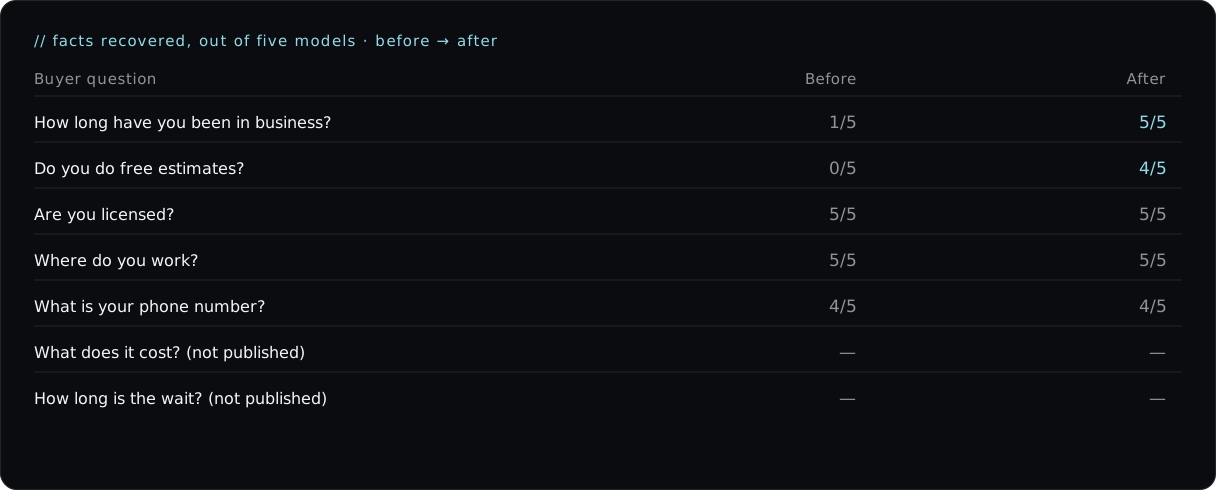
Measured 2026-07-29, 2 runs × 6 models, 39 of 50 fact checks recovered in the strongest arm against 15 of 50 in the control. Source: MARKETING_NOTES_AGENT_VISIBILITY.md, Note 41. The three treatment arms are within noise of each other; all three are far above the control.
the mechanism
Presence is the mechanism, and you should know that before you buy
The sharpest criticism anyone can make of the table above is this: of course recovery rises when you put the answers on the page — the metric asks whether an agent can recover facts, and the intervention adds the facts. We agree, and the arms show it. The spread between the three treatment constructions is 15 points; the gap between any of them and the control is at least 33. What moves the number is the answers being present in the first response at all, not the construction that carries them (Notes 40, 41).
So here is the honest version, stated by us rather than discovered by a skeptic: you can capture most of this gain yourself, free, by writing the answers to your buyers’ questions as plain visible text near the top of your homepage. That is the 63-point arm. If you leave this page and do only that, the measurement says you got most of the way.
What the block adds is presence without spending design real estate — the strongest arm added zero visible copy to the page, because it wraps the paragraph the homepage already shows — and what the package adds around it is everything presence alone cannot do: the same answers rendered to every machine-readable surface from one signed-off profile so no two can disagree, the before-and-after audit that proves what changed, and the drift watch that notices when your pages and your answers stop agreeing. We sell the measurement and the consistency machinery. The mechanism itself is free, and it is honest to say so.
the number that decides the design
1.1 pages
That is the mean crawl depth with a block in place. Agents stop at the homepage. Whatever is not on it does not exist, however good the page four clicks down is — and that single number is why the product is a homepage block rather than a better pricing page.
It is also why the block wraps the paragraph your homepage already shows rather than adding a new one. A visitor sees no change. An agent gets the answers on its first and usually only fetch.
what did not work
Four patterns we tried that lost
- A block injected by a script tag: 0 of 6 recovered. The common extractor strips script bodies before the model ever reads. If the fact is not in the bytes the server sent, it does not exist (Note 23).
- Facts as JSON inside a script tag: never reached a model. Same reason. It is excellent for search engines and worthless for agents, which is why the structured data we ship is labelled as being for search (Note 39).
- Hidden text —
display:noneand the screen-reader clip pattern: 6 of 6, and rejected anyway. They score as well as a visible block and they are the pattern search engines discount as cloaking. Passing our test by sabotaging the client's search performance is not a result, it is a trade nobody agreed to. - A tab or accordion loaded by AJAX on click: nothing. Not in the first response, so not in the answer.
The surviving pattern is a standard user-expandable
<details> toggle, which is ordinary interface behavior and is not
cloaking. That distinction is the entire safety margin, and it is the reason the
hidden-text arms are not offered as an option.
the limits
What this result does not show
Read this before quoting the number
One site, six models, two runs. Confidence scores did not rise — 0.86 to 0.85 (Note 30). The block does not make agents more sure of themselves, only more correct. Facts we deliberately left out of a block stayed unrecovered, with no halo effect: a partial fix is honest, and it is still partial. A single run of a single model moves by several points for reasons that have nothing to do with the site, which is why a weekly result is reported as a check and only a pooled monthly run produces a score.
Every number on this site cites the numbered note that produced it, and those notes include two hypotheses we killed and one result we retracted. If a claim here has no citation beside it, hold us to it.
the audit
Google now audits websites for agent-readiness
Google’s page-quality tooling added an agent-readiness category.
Part of it checks whether a site publishes a machine-readable fact sheet at
/llms.txt, in the expected format, with a real heading. Be precise about
what that means: a site with no file at all is scored not applicable rather than
failed, and it is a file that exists and gets the format wrong that the audit marks
down. Publishing one is also not the same as placing it where it gets read — we
found seven of nine audited sites publishing one, and none of them placed where it
works (Note 09). The full breakdown of every check is in our
explainer.
The package passes the llms.txt and page-structure checks of Google’s agent-readiness audit; the WebMCP audits cover interactive tools a fact package deliberately does not install. That is the whole claim. We do not claim it improves your search position, and anyone who tells you a fact sheet does is selling you something they have not measured.
Verified against the live audit on 2026-07-30. Separately measured, and worth knowing: a fact sheet on its own is close to useless as a discovery mechanism — unpointed agents found it 0 times in 18 visits (Note 15). It passes the audit; the block does the work.
next